
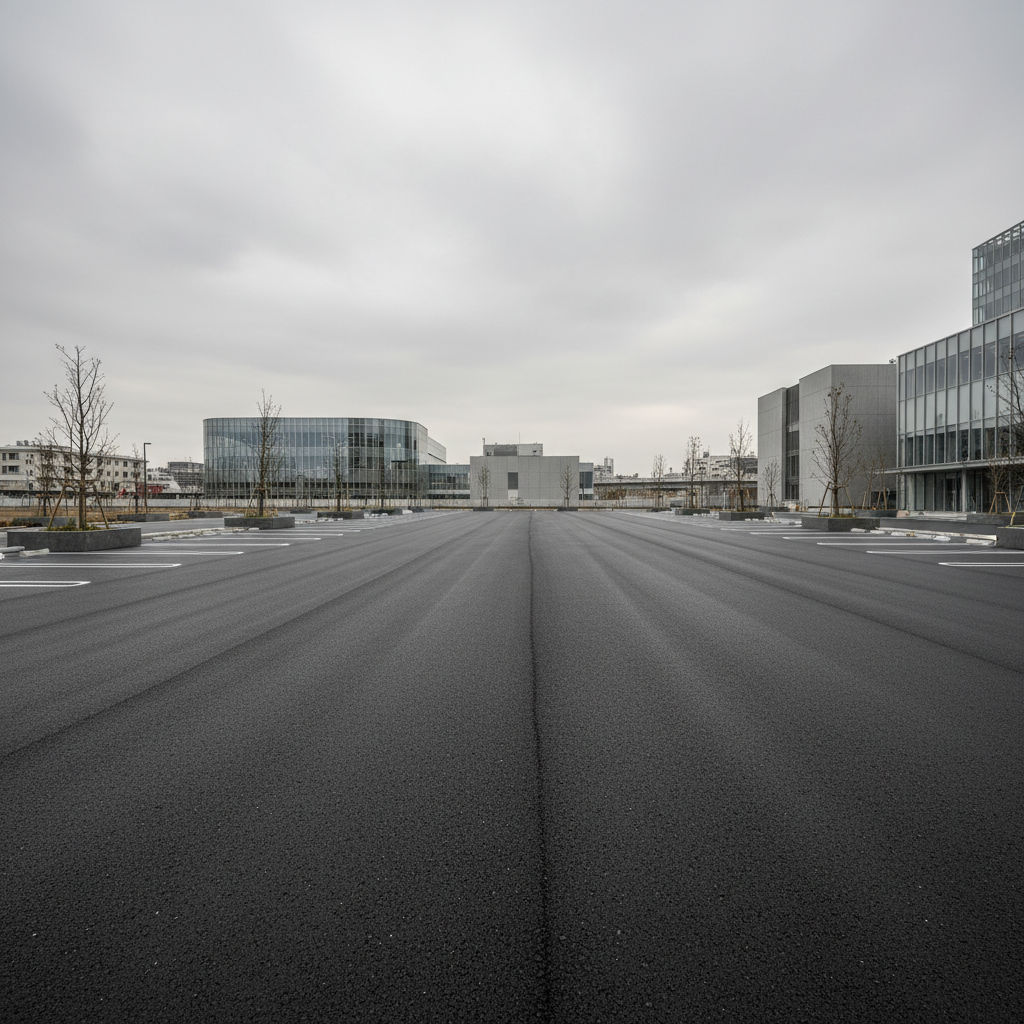
Flush to the
last millimetre.
Driveways, parking lots, municipal roads, and commercial hardscapes across greater Tokyo — laid with precision that holds for decades, not seasons.
Asphalt vs. Concrete vs. Gravel
Twelve factors. Honest numbers. The data your budget meeting needs before the first square metre is quoted.
| Factor | Asphalt(recommended) | Concrete | Gravel |
|---|---|---|---|
Installation Cost (¥/m²) Asphalt delivers hard-surface performance at 40% of concrete cost | ◆¥4,800 – ¥7,200 | ¥14,500 – ¥18,000 | ¥1,200 – ¥2,400 |
Cure / Open Time | ◆24 – 48 hrs | 7 – 28 days | Immediate |
Load Rating Asphalt flexes under load; concrete cracks | ◆Heavy (trucks, buses) | Very heavy | Light–medium |
Drainage Permeable asphalt meets Tokyo stormwater ordinances | ◆Porous option available | Surface runoff only | Excellent — uncontrolled |
Maintenance Cycle | ◆Seal coat every 5–7 yrs | Joint sealing every 3–5 yrs | Regrading every 1–2 yrs |
Winter / Freeze Performance Dark surface accelerates snow melt; no salt damage | ◆Excellent — heat-absorbent | Poor — salt spalling | Poor — frost heave |
Repairability | ◆Patch-and-roll same day | Panel replacement required | Simple but recurring |
Aesthetic Lifespan Resurfacing restores as-new appearance for 30% of install cost | ◆8 – 12 yrs (resealable) | 5 – 8 yrs (staining) | 2 – 4 yrs (displacement) |
Permit Complexity (Tokyo) | ◆Standard — 5–10 days | Standard — 5–10 days | Minimal |
Environmental Rating Reclaimed asphalt pavement (RAP) reduces virgin material by 30% | ◆Recyclable — 99% reclaim | Moderate — CO₂ intensive | Low impact extraction |
Resurfacing Ease | ◆Mill and overlay only | Full demolition required | N/A — top-dress only |
ROI Timeline Lower install + lower lifecycle cost = fastest return for commercial lots | ◆3 – 5 yrs (vs concrete) | Baseline | Negative (recurring) |
Download the
Paving Decision Guide
The full reference document — lifecycle cost models, permit checklists for Tokyo wards, drainage specifications, and a contractor evaluation scorecard — formatted to walk into a budget meeting.
- ◆28-page PDF, printable A4
- ◆Ward-by-ward permit timeline table
- ◆Lifecycle cost calculator (editable)
- ◆Contractor vetting checklist (12 questions)
The Process, Phase by Phase
Nothing is hidden. Every phase below is what actually happens on your site — the equipment, the timeline, and what you should expect to see at each stage.
Site Survey & Soil Assessment
0.5 – 1 dayGround-penetrating radar, soil probes, digital level
Our surveyor walks every metre of the area. You receive a written soil report and drainage map within 48 hours.
Soil Grading & Excavation
1 – 3 daysHydraulic excavator, motor grader, GPS grade control
Existing surface removed to design depth. Sub-grade shaped to 1–2% cross-fall for drainage. Area is cordoned and dustsuppressed.
Sub-Base Compaction
1 – 2 daysVibratory roller (12t), plate compactor, nuclear density gauge
Crushed stone sub-base laid and compacted to ≥95% Proctor density. A density certificate is issued before asphalt begins.
Binder Course (Base Layer)
1 day per 2,000 m²Asphalt paver, tandem roller, infrared thermometer
Hot-mix asphalt (HMA) at 150–160°C laid at 60–80mm depth. You will hear the paver and smell fresh asphalt — both normal and temporary.
Surface Course (Wearing Layer)
1 day per 2,000 m²Fine-mix paver, pneumatic roller, laser screed
Dense-graded fine mix at 40–50mm, rolled to final grade. The surface goes from rough to glassy in real time. This is the layer that reflects the sky.
Final Rolling & Compaction
4 – 8 hoursSteel drum roller (10t), edge iron, thermal camera
Three-pass rolling pattern eliminates voids. Thermal imaging confirms uniform compaction. Surface temperature monitored until it cools below 60°C.
Line Marking & Striping
2 – 4 hours (after 24hr cure)Thermoplastic line marker, stencil set, reflective bead applicator
Parking bays, directional arrows, pedestrian crossings, and any custom markings applied. Surface opens to traffic. Your lot is ready.
Request a Free
Site Survey
Our surveyor visits your site, assesses soil conditions, measures the area, and provides a written quote — usually within 72 hours. No obligation.